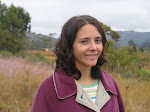


8:25 on a breezy summer evening in Wolford--sipping on a glass of half mint tea, half orange juice, a Ritmo Latina podcast playing, and starry-eyed dreams fluttering as I think of the second half of 2009. Unfortunately this moment will be abruptly interrupted in about 20 minutes with a frenzied shower, throwing on my last pair of clean scrubs and driving 25 miles to work. The drive will, to do it justice, be breath-taking as the sun sets, as goslings swim after their goose-mommies in the sloughs,* a deer and her fawn may dwadle by (and then hopefully break into a sprint the opposite direction of my car), and includes, pretty much daily, an additional wind turbine to the wind farm that's under construction. And, the night shift as a CNA--to do it justice--will glide by quickly (I got lots of sleep today) and I'll leave feeling satisfied and well-worked.
But, on to the starry-eyed dreams... I have four more nights of this job and then I'll be resigning after seven months of working at this long-term care facility. It's been my first experience working as a CNA (certified nursing assistant) and its the sort of thing that I will forever count as useful and would suggest that just about any one take such a job, if even for a short time, just for the perspectives it will grant you. Perhaps there will be more about this some day, but for now I want to talk about my other work--preschool teaching work.
I'm quitting my job, traveling a bit, finishing my paper. And then, I will board a plane to South Africa! From there I'll make my way back up to Mozambique where Joseph is now working in Chimoio. According to the information we're getting, we should, in the time that I'm there, be able to go for a visa interview, and maybe, just maybe, Joseph and I could travel back to the US together in October???
 The last time Jospeh met me at an airport. I think this time I won't wear orange pants.
So these hopes and schemings for the second half of the year include the drama of this dating relationship culminating in a blissful and celebratory marriage.
Again, though, that's not what I want to be writing about.... I want to write about preschool teaching, about guiding children to their highest potential, about guiding children who have so so little opportunity to reach their potential to who they should be, about making learning "lived," about the children and teachers I have worked with, and about the children and teachers I hope to work with this year, and about the children and teachers I hope to work with always.
 Two Mozambican girls helping their mother de-corn the cobs
I have been working on my master's in Early Childhood Education now for about four and a half months and I've learned so much about how to approach teaching children of this age. And it's frustrated me to no end because I'm not teaching. Head knowledge does little good when not practiced. And it seems that, though the prospects are otherwise exciting, the rest of this year won't include having a classroom of my own to pour all this passion and know-how into and see if I can really do what I dream to do.
As a compensation though, I get to go back to the original sketchpad of my career in early childhood education--Chimoio and the Anglican church's programs to start preschools and early primary schools in communities that are itching for growth--economic, organizational, and spiritual.
So here, I present a mini-overview, a beginning to much more communication about this entity. An entity as in the work being done towards the education of the multitudes of tiny, but ever-so-powerful minds. It's an entity that is dynamic, complex, endearing, and powerful.

Mozambique is in southern African, was colonized by the Portuguese (and thus this is the official language now. It's about twice the size of California. It is growing economically, but is still one of the poorest nations in Africa, and in the world. After independence from the Portuguese (1975) they created a Marxist-Leninist government but were soon engaged in civil war that lasted some 17 years (1992).
While in Mozambique, I partnered with the Anglican church as an Ecclesiastical District that covered three provinces, pretty much all of what is nominated as central Mozambique. I worked in two of those provinces, approximately 15 communities spread about 400 km apart.
 The Anglican church in Chimoio on Palm Sunday
 The Anglican church of Mpango, the building behind them is the church.
The communities were mostly rural and thus, mostly everyone was a subsistence farmer. Basically that means that families would spend from 5 a.m to 4 pm every day in their field, with a hoe--no machinery, very rarely even an animal with a plow to cultivate, sow, weed and harvest the crops that they would eat for the rest of the year, perhaps they would sell some to have a bit of cash. Food security is a constant struggle.
Because everyone farms, groups of people often move on to new areas that have un-cultivated land. This creates large communities that do not have access to potable water, health facilities, basic goods, and of course, education.
So the Anglican church would open churches in these communities and discover the seemingly unendless needs. Education was one that the church was able to focus on and they started organizing primary schools that would meet in their churches. One priest and his wife had been trained as preschool teachers and they started a preschool.
My work (2004-2008)
I had lived in Beira, a large city in central Mozambique in 2002. and worked at a daycare. This was after receiving an associates' degree in ECE. I saw so much that could be, but was not being done to nurture the children in the daycare, I saw a level of suffering that seemed (and still seems) completely unfair, and I fell in love with the people of Mozambique. So after finishing my bachelor's degree, I returned. This time I lived in Chimoio, a fairly large city further inland, but more central to the areas where I worked with preschools.
I visited communities as they expressed interest in starting a preschool in order to gain insight into what daily life was like for them and the children. I would train the teachers in some basic pedagogy, visit again several times, create resources and toys. I fumbled around a lot, learned a lot.
After a few years, I started training a young guy to coordinate the activity. We started supporting a few of the schools with breakfasts, seeds, educational materials.
Now there are around 10-13 (not sure how many made it through this year), preschools and a handful of primary schools that are still being supported by MCC and the Anglican church.There's a lot more to say about them...and I will. But I'm certain I've already taken too much of your time, and my homework is becoming stagnant as it sits in the same place and my stomach is growling with hunger. So, it will wait for another day.
What I plan to do:
So since I'll be back in Chimoio, the hub of this activity. I'm really excited about putting some of what I've been learning into practice. I will probably be able to spend time in the preschool classroom there, observing, assessing, finding ways to make the curriculum they are using more "lived", and then hopefully, I'll be able to do some more teacher training towards the end of my stay. So, please, if you're interested, stay tuned...
*A slough (pronounced slew) is the northern word for standing water in a field, it may or may not be permanent; they're usually nice to look at (not scummy on the top or anything), but they most certainly will always be layered with a 2 feet or so of mush at the bottom making them completely unswimmable, not to mention the duck lice, and there are no fish for fishing. I don't actually ever recall be in one though, so if you'd like more information, ask my brother Carl who waded in to get some cattail roots (good, refreshing eatin').
Carl and his stunning wife, Kristin, by a slough and cattails ready for harvest.

No comments:
Post a Comment